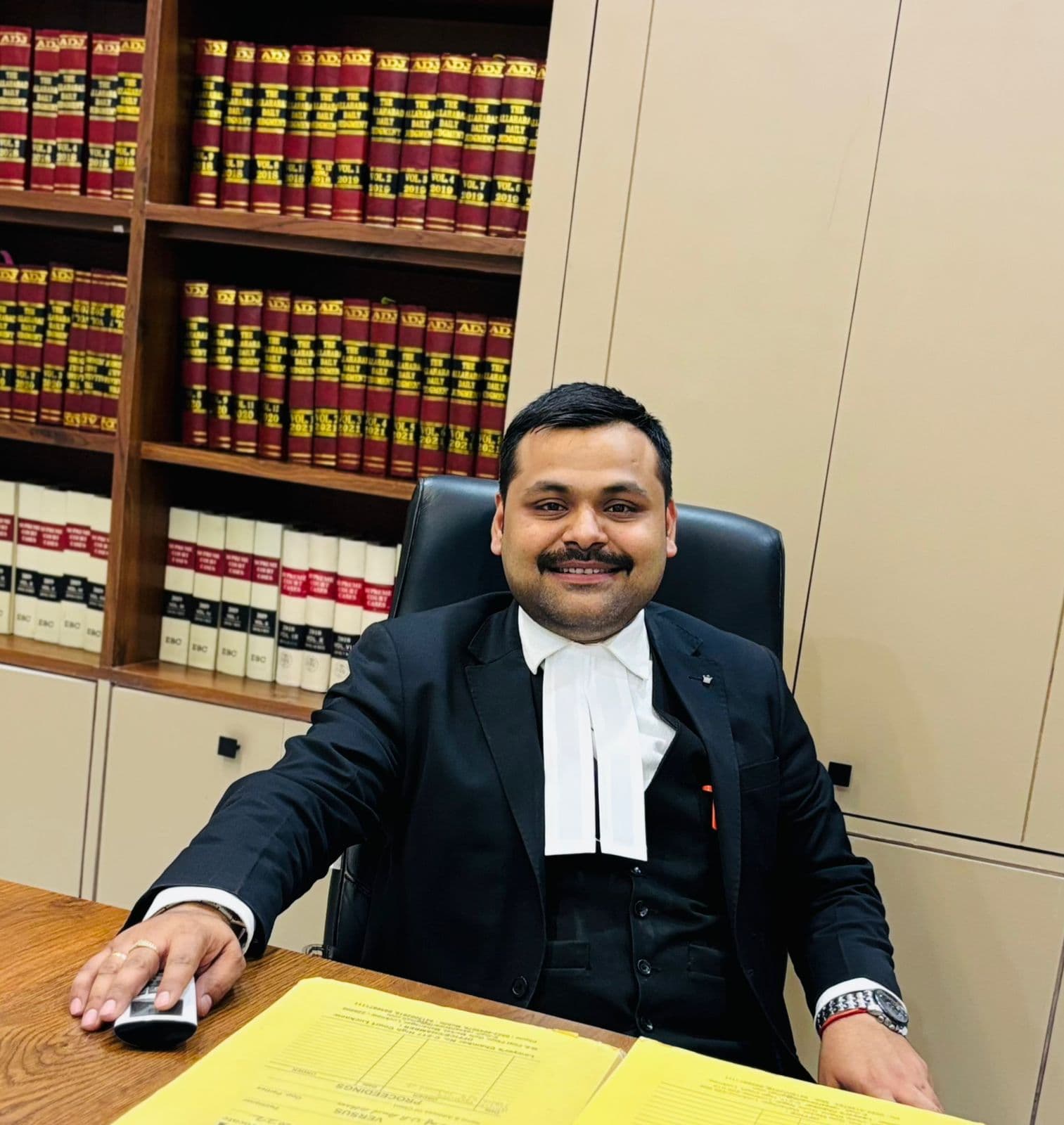

Adv. Aditya Narayan Shukla
Senior Associate Advocate
Delhi, Lucknow & Prayagraj
B.A., LL.B. (University of Lucknow)
- Criminal Matters
- Civil Matters
- Tax Matters
Our service matter advocates and employment lawyers in Lucknow advise government employees, public-sector staff, teachers, and private employees facing suspension, departmental inquiries, dismissal, promotion, pay, or pension disputes. We assess the applicable service rules and the appropriate remedy before the CAT Lucknow Bench, U.P. Public Services Tribunal, labour forums, or the Allahabad High Court, Lucknow Bench.
Adv. Jitendra Tiwari leads our service and employment practice alongside Adv. Aditya Narayan Shukla, Adv. Devesh Tiwari, and Adv. Abhishek Mishra. Each profile below sets out that member's individual practice areas.
Senior Associate Advocate

Associate Advocate
Reach our Lucknow team at Shushant Golf City or our chamber at the Allahabad High Court, Lucknow Bench in Gomti Nagar. Please call to confirm the appropriate chamber and arrange your consultation before visiting.
Identify your employer, service rules and the challenged order before comparing advocates. Ask about departmental inquiries, suspension, dismissal, recruitment or pension disputes, and whether CAT, the UP Public Services Tribunal, a labour forum or the High Court is competent. Review limitation, departmental remedies and interim relief with the appointment letter and orders. Confirm representation and fees in writing; no advocate can guarantee reinstatement, promotion or pension relief.
Sumanjari & Co. Advocates is a second-generation law firm with 30+ years of legal experience and 10,000+ cases solved by its team. Each advocate's individual practice areas are listed on their profile; no outcome is guaranteed.
Service law governs employment relationships arising under statutory rules, service regulations, and administrative instructions. For government employees, public sector staff, teachers, personnel of statutory bodies, and workmen in private employment, disputes over recruitment, promotion, disciplinary action, retrenchment, or retirement benefits can directly affect a career and livelihood.
Sumanjari & Co. Advocates advises and represents employees and, where instructed, departments — from the departmental inquiry stage through departmental appeals and, where maintainable, tribunal or court proceedings. The correct route depends on the legal status of the employer, the post held, the governing rules, and where the cause of action arose. Central and State Government service disputes, aided-institution matters, and private employment claims do not all follow the same procedure.
Advice on replies, evidence, departmental appeals, and review petitions. Assistance or representation during an inquiry depends on the applicable service rules and permission requirements.
Claims by public servants covered by the U.P. Public Services (Tribunal) Act, 1976, filed at the Tribunal at Indira Bhawan, Ashok Marg, Hazratganj, Lucknow. Eligibility, available departmental remedies, and limitation must be checked before filing; not every public-sector post is covered.
Recruitment and service disputes within the Administrative Tribunals Act, 1985, heard at the CAT Lucknow Bench, Vipin Khand, Gomti Nagar, Lucknow, including covered Central Government posts and notified organisations. PSU employment alone does not establish CAT jurisdiction; bench jurisdiction also needs checking.
Industrial disputes within the central labour jurisdiction, before the CGIT-cum-Labour Court at Sector H, Aliganj, Lucknow, subject to employee status and the applicable statutory procedure. Other employment disputes may belong before State labour forums or a civil court; CGIT is not the default forum for every private employee.
Service writ petitions under Article 226 and judicial review of tribunal decisions, subject to maintainability, alternative remedies, and territorial jurisdiction. A Lucknow address alone does not establish jurisdiction.
Advice on POSH complaints, responses, inquiry procedure, and available appeals. Legal practitioners cannot represent either party before the Internal Committee under the POSH Rules.
Consultations can be arranged by prior appointment for employees across these Lucknow localities. These are areas served, not separate branch offices. A Lucknow address alone does not establish tribunal or court jurisdiction; employer coverage, the challenged order and territorial rules determine where to file.
Gomti Nagar, Vibhuti Khand, Indira Nagar, Aliganj, Jankipuram, Mahanagar
Hazratganj, Kaiserbagh, Lalbagh
Ashiyana, Alambagh, Telibagh, Transport Nagar
Rajajipuram, Chowk, Thakurganj, Dubagga
The employer, post, actual duties and applicable rules determine the remedy. Verify current notifications, labour-law commencement and transitional provisions, as well as tribunal coverage and limitation; public and private employment do not follow a single procedure.
| Law | Key provisions | Where it matters |
|---|---|---|
| Constitution of India | Articles 14, 16, 226, 309 and 311 where applicable | Public-employment equality, statutory service rules, constitutional safeguards for covered civil servants and judicial review. These do not create a general writ right against every private employer. |
| Administrative Tribunals Act, 1985 | Sections 14 and 19 to 22; applicable coverage notifications | CAT jurisdiction, applications, departmental remedies, limitation and procedure. Check employer and post coverage, exclusions and territorial allocation before approaching the Lucknow Bench. |
| U.P. Public Services (Tribunal) Act, 1976 | Public-servant coverage, exclusions and claim provisions; applicable limitation and procedure | Covered state public-service claims before the tribunal. Coverage differs from CAT, and not every dispute involving a state-funded or public-sector body belongs here. |
| Applicable public-service disciplinary rules | U.P. Government Servant (Discipline and Appeal) Rules, 1999; CCS (CCA) Rules, 1965 where governing the employee | Authority, charge sheets, inquiry safeguards, penalties and departmental appeals. Verify the actual service rules rather than applying central and state procedures interchangeably. |
| Recruitment, pay and retirement rules for the particular service | Applicable cadre rules, recruitment advertisement, pension scheme and binding government orders | Eligibility, seniority, promotion consideration, pay fixation and pension entitlement depend on the relevant service and scheme; a general grievance alone does not establish the claimed benefit. |
| Industrial Relations Code, 2020 and applicable industrial-relations legislation | Coverage, appropriate-government, conciliation and adjudication provisions; current commencement, savings and transitional rules | Covered employment disputes require checking actual duties, establishment coverage and the currently competent notified tribunal or labour forum. Earlier proceedings and state practice need separate verification. |
| Applicable wage, gratuity and social-security legislation | Relevant benefit, claim and appeal provisions, including commencement and transitional arrangements | A wage, gratuity or retirement-benefit claim may have a designated statutory authority distinct from the tribunal hearing a termination dispute. The employee and establishment must satisfy the governing coverage rules. |
| POSH Act, 2013 and Rules, 2013 | Sections 11, 13, 16 and 18; Rule 7 | Inquiry procedure, recommendations, confidentiality and the applicable appeal. Legal advice on preparation is distinct from representation inside an Internal Committee inquiry, which the Rules prohibit for legal practitioners. |
The employer category decides the governing statute, the disciplinary rules and the Lucknow forum. Confirm current coverage notifications and limitation before choosing between the UPPST, CAT, the labour forums and a Writ-A petition.
| Law | Key provisions | Where it matters |
|---|---|---|
| Covered State Government & UP PSU Employees | U.P. Public Services (Tribunal) Act, 1976 (Section 4 claim petitions) & U.P. Government Servant (Discipline and Appeal) Rules, 1999 (Rule 4 suspension, Rule 7 major penalty inquiry) | Forum: U.P. Public Services Tribunal (UPPST), Indira Bhawan, Hazratganj, subject to statutory coverage and exclusions. High Court review is subject to maintainability and territorial jurisdiction. |
| Covered Central Government Posts & Notified Organisations | Administrative Tribunals Act, 1985 (Section 19 Original Applications, Section 20 exhaustion of remedies, Section 21 limitation) & CCS (CCA) Rules, 1965 (Rule 10 & Rule 14) | Forum: Central Administrative Tribunal (CAT), Lucknow Bench, Vipin Khand, Gomti Nagar, Lucknow, with Division Bench writ review before the Allahabad High Court, Lucknow Bench per L. Chandra Kumar. |
| Constitutional Protections & Retiral Recovery | Articles 14, 16, 226 & 311(2) where applicable; applicable pension rules, including Article 351-A Civil Service Regulations where governing the employee | Review pension withholding separately from recovery of excess payments. Rafiq Masih concerns specified recovery situations; sanction, event-based restrictions, exceptions and the applicable service rules require individual assessment. |
| Compassionate Appointment (Dying-in-Harness) | U.P. Recruitment of Dependants of Government Servants Dying in Harness Rules, 1974 | Assess dependency, eligibility, financial circumstances, time limits and the current scheme. Compassionate appointment is not an automatic entitlement. |
| Covered Industrial Employees & Private Employment Claims | Industrial Relations Code, 2020 and applicable earlier industrial-disputes legislation, subject to commencement and transitional provisions; POSH Act, 2013 | Verify actual duties, appropriate-government jurisdiction and the currently competent labour forum. Contractual claims may require a civil remedy; POSH inquiries follow a separate procedure. |
Keep the complete order, notice, envelope, or email showing when it reached you. A charge-sheet reply, departmental appeal, tribunal application, and writ petition have different procedural requirements. An informal assurance from the department or a fresh representation should not be treated as an extension of time.
For Central Government matters, Sections 20 and 21 of the Administrative Tribunals Act, 1985 address departmental remedies and limitation. U.P. Tribunal claims are governed by the U.P. Public Services (Tribunal) Act, 1976, including its limitation provisions. Departmental appeal periods depend on the disciplinary rules applicable to your post. Writ petitions can also be refused for unexplained delay even where no fixed statutory period applies.
If an order has immediate consequences, seek advice on any available interim application. Until a competent authority or court grants relief, filing a representation or case does not by itself stay the order. Do not assume you can disregard it.
Bring the records available to you; do not delay seeking advice solely because a document is missing. A first review should identify the available remedy, missing evidence, urgency, and proposed scope of work, rather than promise a particular result.
We begin with a confidential review of your service record, charge sheet, or the order under challenge, followed by clear advice on the likely outcomes and the forum best suited to your matter. We represent you at the departmental stage wherever possible, and are fully prepared to carry the matter before the Central Administrative Tribunal, the U.P. Public Services Tribunal, CGIT, or in writ jurisdiction before the Allahabad High Court, Lucknow Bench.
From challenging a prolonged suspension to enforcing reinstatement, each stage identifies the governing rule and the Lucknow forum involved. Not every matter needs every stage; the route depends on the employment category and the order under challenge.
Stage 1
Forum: Disciplinary authority; UPPST, Indira Bhawan, Hazratganj or CAT, Lucknow Bench, Vipin Khand, Gomti Nagar, as applicable
Suspension is not a punishment in itself, but a prolonged or procedurally defective suspension may be challenged. We examine the order, review record, charge-sheet status and governing rules, including the principles discussed in Ajay Kumar Choudhary v. Union of India. Central and State service rules are not interchangeable: a 90-day review requirement must not be assumed to apply identically to every employee. Revocation, subsistence allowance and interim relief depend on the applicable rules and facts.
Preserve the suspension order, proof of the date it was served and every review order or extension. For Central Government employees, CCS (CCA) Rule 10 applies; for State employees, Rule 4 of the U.P. Government Servant (Discipline and Appeal) Rules, 1999. The remedy and forum differ between the two, so the governing rule must be confirmed before filing.
Key provisions: Ajay Kumar Choudhary v. Union of India (principles on prolonged suspension); Rule 4, U.P. Government Servant (Discipline and Appeal) Rules, 1999 where applicable; Rule 10, CCS (CCA) Rules, 1965 where applicable
Stage 2
Forum: Disciplinary authority and inquiry officer, under the governing conduct and discipline rules
A charge-sheet reply must answer each allegation with documents, request the relied-upon documents that have not been supplied, and record objections to vague or unsupported charges. Under Rule 7 of the U.P. CCA Rules, 1999 and Rule 14 of the CCS (CCA) Rules, the delinquent employee is entitled to the relied-upon material, to examine oral evidence and to cross-examine witnesses. Failure to supply documents or a fair opportunity is a recognised procedural defect.
If the inquiry report is adverse, the non-furnishing of that report to the employee before the penalty decision is itself a ground of challenge under ECIL v. B. Karunakar. We track the report, the disagreement note and the show-cause on the proposed penalty so each procedural safeguard is preserved in the record for later tribunal or writ review.
Key provisions: Rule 7, U.P. CCA Rules, 1999 / Rule 14, CCS (CCA) Rules, 1965; ECIL v. B. Karunakar (supply of inquiry report); Article 311(2), Constitution of India for covered civil servants
Stage 3
Forum: Departmental appellate or revisional authority specified in the service rules
A punishment order is ordinarily challenged first through the departmental appeal or revision provided by the applicable rules, within the prescribed period. The appeal should address the findings, the evidence, the procedural objections and the proportionality of the penalty. An informal representation to a different officer is not the prescribed appeal and does not protect limitation.
Tribunal legislation generally expects available departmental remedies to be pursued before an application is filed, subject to the statutory waiting windows. We record the appeal filing, any acknowledgment and the expiry of the statutory period so the tribunal filing that follows is not met with a maintainability objection.
Key provisions: Section 20, Administrative Tribunals Act, 1985 (exhaustion of remedies); Applicable departmental appeal and revision rules; Section 21, Administrative Tribunals Act, 1985 (limitation) where applicable
Stage 4
Forum: CAT, Lucknow Bench, Vipin Khand, Gomti Nagar; or UPPST, Indira Bhawan, Hazratganj, Lucknow
Employees and recruitment applicants within CAT coverage may file an Original Application under Section 19 of the Administrative Tribunals Act, 1985 before the territorially competent bench. Coverage of central autonomous bodies and public-sector organisations depends on the applicable notifications, not the employer label alone. Public servants covered by the U.P. Public Services (Tribunal) Act, 1976 may pursue a Section 4 claim before the UPPST at Indira Bhawan, Hazratganj. The two forums have different exclusions, forms and limitation rules.
The pleading must identify the exact relief, the necessary parties and the complete record, with the challenged order and earlier proceedings annexed. Interim protection, where justified, needs a specific reasoned request; filing alone does not stay the order. Coverage, territorial allocation and limitation are verified before filing.
Key provisions: Section 19, Administrative Tribunals Act, 1985 (Original Applications); Section 4, U.P. Public Services (Tribunal) Act, 1976 (claim petitions); L. Chandra Kumar (High Court review of tribunal decisions)
Stage 5
Forum: Allahabad High Court, Lucknow Bench (Chamber D-311), under Article 226
A direct service writ under Article 226 requires a separate maintainability assessment; transfer, suspension, promotion or pension grievances do not automatically permit bypassing the competent tribunal. Review the available statutory remedy, any recognised exception and territorial jurisdiction before approaching the Allahabad High Court, Lucknow Bench. K.V. Jankiraman concerns sealed-cover promotion procedure, while State of Punjab v. Rafiq Masih concerns recovery of excess payments in specified circumstances, not a general bar on withholding pension or gratuity. Post-retirement proceedings require checking the applicable pension rules, sanction requirements and restrictions on the events that may be investigated.
Writ review of a tribunal decision is not a fresh merits appeal; the petition must identify illegality, procedural unfairness or a recognised ground of interference. Maintainability, alternative remedies and territorial jurisdiction are assessed before filing from Chamber D-311.
Key provisions: Articles 14, 16, 226 and 311(2), Constitution of India; State of Punjab v. Rafiq Masih (bar on recovery from Class III/IV and retired employees); K.V. Jankiraman (sealed-cover promotion procedure)
Stage 6
Forum: CGIT-cum-Labour Court, Sector H, Aliganj, Lucknow; Labour Court Lucknow; Civil/Commercial Courts
Covered industrial employees may follow the industrial-dispute track rather than the public-service tribunals. Check actual duties, establishment coverage, the appropriate government and current commencement, savings and transitional provisions before selecting a remedy under the Industrial Relations Code, 2020 or earlier industrial-disputes legislation. A bank or private-sector job title does not itself establish workman status or CGIT jurisdiction. Conciliation, adjudication and recovery proceedings have different requirements, and some contractual claims belong before a civil court.
Wrongful dismissal, notice-pay recovery and wage claims are built on the employment contract, appointment terms, payslips and termination record. Statutory coverage depends on actual duties, not the job title; POSH Act, 2013 matters follow their own Internal Committee procedure, in which legal practitioners advise on preparation but cannot appear as representatives.
Key provisions: Industrial Relations Code, 2020; applicable commencement, savings and transitional provisions; Earlier industrial-disputes legislation where applicable; POSH Act, 2013 and Rules, 2013
Stage 7
Forum: The tribunal or court that granted relief; implementing department and accounts authorities
A favourable order still requires implementation. We track the operative directions for reinstatement, seniority refixation, pay and pension arrears disbursal, and consequential benefits against what the department actually does. The operative order is communicated through the proper channel with acknowledgment preserved, and benefit calculations are checked against what was actually awarded.
Where the department does not comply within the stipulated period, contempt petitions and time-bound compliance applications are pursued before the forum that granted relief. Any departmental challenge, review or appeal by the employer is answered separately; a stay sought by the department does not automatically erase the existing direction.
Key provisions: Contempt jurisdiction of the granting tribunal or court; Articles 226 and 227, Constitution of India where applicable; Applicable implementation, review and appeal provisions
Answers on departmental proceedings, service tribunals, employment remedies, and preparing for a consultation in Lucknow.
A service law advocate reviews recruitment, appointment, suspension, disciplinary action, promotion, pay, and pension disputes against the rules governing your post. The first step is to identify your employer, employment status, challenged order, and the authority or court that can grant a remedy.
Ask Us About This →Record the date of receipt and the reply deadline. Check each allegation against the applicable conduct and disciplinary rules, request relied-upon documents where needed, and prepare a point-by-point reply supported by records. Seek an extension promptly if necessary; do not assume it has been granted or ignore the notice.
Ask Us About This →A review may consider eligibility, vacancies, recruitment rules, the seniority list, service-record entries, and the Departmental Promotion Committee process. Keep the relevant orders and submit objections within any notified period. The available remedy depends on your service rules; eligibility does not automatically guarantee promotion.
Ask Us About This →Collect your retirement order, pension payment order, service and pay records, calculation sheets, and earlier representations. A review can identify missing service periods, incorrect calculations, or the stated reason for withholding benefits. Arrears and interest may be sought where legally available, but depend on the applicable rules and facts.
Ask Us About This →CAT generally hears covered Central Government service matters; the U.P. Public Services Tribunal hears claims within its statutory coverage. For matters assigned to a tribunal, that tribunal ordinarily acts as the court of first instance, with High Court judicial review available afterwards. Employer status, statutory exclusions, departmental remedies, and territorial jurisdiction must be checked before choosing a forum.
Ask Us About This →Interim relief can be requested from the competent forum where the facts and law justify it. Filing a challenge does not itself suspend the order. The forum considers factors such as a prima facie case, balance of convenience, and irreparable harm; transfer and disciplinary matters have specific limits on judicial intervention. No stay or reinstatement can be guaranteed.
Ask Us About This →There is no single deadline for all service disputes. A departmental reply, statutory appeal, CAT application, and U.P. Tribunal claim can each have different time limits. Record when the order was communicated and obtain advice promptly. Repeated representations do not automatically extend limitation, and the power to excuse delay differs between forums.
Ask Us About This →A private employment dispute does not automatically qualify for a writ petition. The employer, any public-law duty, your actual duties, and the governing employment law determine whether a labour remedy, civil claim, contractual process, or exceptional writ remedy is available. Keep the employment contract, termination notice, payslips, and relevant correspondence.
Ask Us About This →Fees depend on the records to review, the forum, urgency, drafting, and the stages of representation required. Ask for the proposed scope, professional fees, and separate filing or incidental expenses before instructing counsel. The likely duration depends on the proceedings and cannot be promised in advance.
Ask Us About This →यह सामान्य कानूनी जानकारी है, किसी विशेष मामले की सलाह नहीं। लागू सेवा नियमों, तथ्यों और संबंधित मंच के आदेश के अनुसार प्रक्रिया बदल सकती है।
सही मंच नियोक्ता, पद, लागू सेवा नियमों और विवाद के प्रकार पर निर्भर करता है। CAT में अधिनियम के दायरे में आने वाले केंद्रीय कर्मचारियों और अधिसूचित संस्थाओं के मामले जाते हैं। उत्तर प्रदेश लोक सेवा अधिकरण में उसके कानून के अंतर्गत आने वाले लोक सेवकों के दावे जाते हैं। निजी रोजगार और श्रम विवादों की प्रक्रिया अलग हो सकती है। अधिकरण के अधिकार क्षेत्र वाले मामलों में सामान्यतः पहले वहीं जाना होता है; हाईकोर्ट की न्यायिक समीक्षा अलग प्रक्रिया है। केवल लखनऊ में रहने से हर मामले का अधिकार क्षेत्र यहाँ नहीं बनता।
आदेश मिलने की तारीख और जवाब की अंतिम तारीख लिखें। पूरा आरोप पत्र, संलग्न दस्तावेज, नियुक्ति पत्र और लागू सेवा नियम सुरक्षित रखें। हर आरोप का रिकॉर्ड के आधार पर जवाब तैयार करें और आवश्यक दस्तावेज माँगें। समय चाहिए तो विस्तार का अनुरोध करें, लेकिन स्वीकृति अपने आप मिली हुई न मानें। निलंबन की समीक्षा और निर्वाह भत्ते के नियम कर्मचारी की सेवा के अनुसार अलग होते हैं। अपील या मुकदमा दाखिल करने से आदेश अपने आप स्थगित नहीं होता।
सभी सेवा विवादों की एक जैसी समय-सीमा नहीं है। विभागीय अपील, CAT की अर्जी और राज्य अधिकरण के दावे की अवधि अलग हो सकती है। आदेश की प्रति, प्राप्ति का प्रमाण, सेवा पुस्तिका, वेतन या पेंशन रिकॉर्ड और पहले किए गए आवेदन साथ रखें। बार-बार प्रार्थना पत्र देने से समय-सीमा अपने आप नहीं बढ़ती। देरी माफ करने की शक्ति भी मंच के अनुसार बदलती है, इसलिए जल्द मामले की समीक्षा कराएँ। किसी लाभ, स्थगन या निर्णय की गारंटी नहीं दी जा सकती।
स्थानांतरण सामान्यतः सेवा का हिस्सा है और केवल असुविधा होने से आदेश रद्द नहीं होता। सक्षम अधिकारी का अधिकार, लागू वैधानिक नियम, दुर्भावना के ठोस तथ्य और आदेश की वास्तविक प्रकृति की समीक्षा की जा सकती है। स्थानांतरण आदेश, नीति, सेवा नियम और संबंधित पत्राचार सुरक्षित रखें। केवल नीति से विचलन हर मामले में न्यायिक हस्तक्षेप का आधार नहीं होता। जब तक सक्षम अधिकारी या मंच स्थगन न दे, आदेश को अपने आप निष्प्रभावी न मानें।
भर्ती और पदोन्नति नियम, पात्रता, रिक्तियाँ, वरिष्ठता सूची, सेवा रिकॉर्ड और विभागीय पदोन्नति समिति की प्रक्रिया देखें। सूची पर आपत्ति के लिए निर्धारित अवधि हो तो उसके भीतर तथ्य और दस्तावेज सहित आपत्ति दें। पात्रता होने से पदोन्नति अपने आप सुनिश्चित नहीं होती। यदि किसी अन्य कर्मचारी की वरिष्ठता या पदोन्नति प्रभावित होगी, तो कार्यवाही में आवश्यक पक्षकारों का भी ध्यान रखना पड़ता है। उपलब्ध उपाय और समय-सीमा की अलग समीक्षा कराएँ।
आरोपों के समर्थन में जिन दस्तावेजों पर भरोसा किया गया है, उनकी प्रतियाँ और आवश्यक रिकॉर्ड लिखित रूप से माँगें। अनुरोध, जवाब और सुनवाई में उठाई गई आपत्तियों का प्रमाण रखें। लागू नियमों के अनुसार गवाहों से प्रश्न करने, अपना पक्ष रखने और प्रतिकूल जाँच रिपोर्ट पर जवाब देने का अवसर जाँचा जाता है। किसी प्रक्रियात्मक कमी का परिणाम उसके प्रभाव, लागू नियमों और मामले के तथ्यों पर निर्भर करता है; हर कमी से दंड आदेश अपने आप रद्द नहीं होता।
निर्वाह भत्ते की पात्रता और दर लागू सेवा नियमों तथा आवश्यक प्रमाणपत्रों पर निर्भर करती है। निलंबन आदेश, वेतन विवरण, भुगतान रिकॉर्ड और विभाग को दिए गए आवेदन इकट्ठा करें। भुगतान न होने या गलत गणना की लिखित शिकायत सक्षम अधिकारी को दें और प्राप्ति का प्रमाण रखें। यदि इससे जाँच में अपना बचाव करने में कठिनाई हो रही है, तो उसे भी रिकॉर्ड पर रखें। आगे की राहत सही मंच और तथ्य देखकर तय होती है।
बहाली और पिछला वेतन हर मामले में स्वतः नहीं मिलता। नियुक्ति की प्रकृति, सेवा समाप्ति का कारण, जाँच की निष्पक्षता, लागू कानून और माँगी गई राहत की समीक्षा करनी होती है। अंतिम आदेश, जाँच रिकॉर्ड, नियुक्ति पत्र और अपील से संबंधित कागजात रखें। सक्षम मंच आदेश रद्द करने, पुनर्विचार, बहाली या अन्य राहत पर विचार कर सकता है। पिछला वेतन, अन्य रोजगार और परिणामी लाभ अलग प्रश्न हैं; किसी निश्चित परिणाम का वादा नहीं किया जा सकता।
पेंशन या ग्रेच्युटी रोकना और पहले हुए अधिक भुगतान की वसूली अलग कानूनी प्रश्न हैं। पेंशन भुगतान आदेश, गणना पत्र, सेवा रिकॉर्ड, रोकने या वसूली का आदेश और विभाग का कारण देखें। संबंधित पेंशन नियम, लंबित कार्यवाही और आदेश देने वाले अधिकारी की शक्ति की जाँच जरूरी है। रफीक मसीह का निर्णय कुछ परिस्थितियों में अधिक भुगतान की वसूली से संबंधित है; उसे हर पेंशन रोकने के मामले पर लागू न मानें। बकाया या ब्याज की राहत लागू कानून और तथ्यों पर निर्भर करती है।
सामान्य निजी रोजगार विवाद केवल नौकरी से संबंधित होने के कारण CAT या राज्य सेवा अधिकरण के अधिकार क्षेत्र में नहीं आता। वास्तविक कार्य, नियुक्ति अनुबंध, प्रतिष्ठान का स्वरूप और लागू श्रम कानून देखकर सही प्रक्रिया चुनी जाती है। कुछ विवाद श्रम मंच, वैधानिक प्राधिकारी या दीवानी अदालत में जा सकते हैं; निजी नियोक्ता के खिलाफ रिट भी अपने आप उपलब्ध नहीं होती। नियुक्ति पत्र, वेतन पर्चियाँ, समाप्ति नोटिस और पत्राचार साथ रखें।
अनुकंपा नियुक्ति सामान्य भर्ती का विकल्प या स्वतः मिलने वाला अधिकार नहीं है। लागू योजना, आश्रित की पात्रता, परिवार की आर्थिक स्थिति, आवेदन की अवधि और अस्वीकृति के कारण देखें। मृत्यु प्रमाणपत्र, सेवा विवरण, परिवार और आय से संबंधित रिकॉर्ड तथा आवेदन और आदेश की प्रतियाँ रखें। समीक्षा में नियमों के पालन और निर्णय के कारणों को परखा जाता है; केवल पारिवारिक संबंध होने से नियुक्ति सुनिश्चित नहीं होती।
लंबे समय तक काम करने से नियमितीकरण अपने आप नहीं होता। नियुक्ति की प्रक्रिया, स्वीकृत पद, योग्यता, लागू नियम या योजना और बाध्यकारी न्यायिक निर्णय देखना जरूरी है। नियुक्ति और नवीनीकरण पत्र, भुगतान रिकॉर्ड, काम की अवधि और पद से संबंधित उपलब्ध दस्तावेज रखें। समान वेतन, बकाया भुगतान और नियमितीकरण अलग दावे हो सकते हैं; प्रत्येक की कानूनी शर्तों की अलग समीक्षा की जाती है।
POSH नियमों के तहत आंतरिक समिति की जाँच में कोई भी पक्ष विधिक व्यवसायी के माध्यम से प्रतिनिधित्व नहीं कर सकता। वकील शिकायत या जवाब तैयार करने, दस्तावेज समझने, प्रक्रिया की समीक्षा और उपलब्ध अपील पर सलाह दे सकता है। शिकायत, जवाब, समिति के नोटिस, रिपोर्ट और संचार सुरक्षित रखें तथा कार्यवाही की गोपनीयता का पालन करें। शिकायत या अपील की समय-सीमा और सही प्राधिकारी की तुरंत जाँच करें।
पहले आदेश के वास्तविक निर्देश, पालन की अवधि और किसी बाद के स्थगन आदेश को देखें। आदेश विभाग को उचित माध्यम से भेजें और प्राप्ति का प्रमाण रखें। वेतन, वरिष्ठता, बहाली या पेंशन के लाभ उतने ही माँगें जितने आदेश में दिए गए हैं। अनुपालन आवेदन, निष्पादन या अवमानना जैसे उपाय संबंधित मंच की शक्तियों और परिस्थितियों पर निर्भर करते हैं। केवल अपील दाखिल होने से आदेश अपने आप स्थगित नहीं होता।
नियुक्ति पत्र, लागू सेवा नियम, विवादित आदेश और उसकी प्राप्ति का प्रमाण, संबंधित वेतन या पेंशन रिकॉर्ड, पहले किए गए आवेदन और अदालत के आदेश लाएँ। घटनाओं और आगामी तारीखों की छोटी सूची भी उपयोगी है। कोई दस्तावेज न हो तो केवल उसी कारण सलाह लेने में देरी न करें। काम का दायरा, सलाह और ड्राफ्टिंग की फीस, सुनवाई का खर्च तथा अलग दाखिला या प्रतिलिपि शुल्क पहले स्पष्ट कर लें। फीस और मामले की अवधि एक जैसी नहीं होती।
Identify the employer, appointment terms, applicable service rules and the stage of proceedings before choosing a remedy. A departmental inquiry, statutory appeal, CAT application, U.P. Public Services Tribunal claim, industrial dispute and High Court writ are not interchangeable. Armed forces service matters may engage the Armed Forces Tribunal, subject to its statutory jurisdiction and exclusions. Private employment claims require a separate assessment of the contract, duties and applicable labour law.
Share the appointment letter, service rules, charge sheet and annexures, inquiry notices, replies, inquiry report, challenged order and proof of its communication. For pay or pension disputes, add service-book extracts, pay fixation and retirement records. Record each reply, appeal and hearing deadline. Repeated representations do not necessarily extend limitation or suspend the order. We assess natural justice, available departmental remedies and the basis for any interim relief; reinstatement or a stay cannot be assured.
Short reads on service law, employment disputes, and departmental proceedings.
A step-by-step legal guide to challenging unlawful suspension orders and departmental charge sheets in India.
Read Article →INQUIRIES, DISMISSAL PROTECTIONS & ARTICLE 311(2) EXCEPTIONS
Read Article →RULE 7 UP CCA RULES 1999 & VAGUE CHARGE SHEETS
Read Article →AJAY KUMAR CHOUDHARY 90-DAY RULE & ALLOWANCE ARREARS
Read Article →JUDICIAL REVIEW OF SHOCKINGLY DISPROPORTIONATE PUNISHMENTS
Read Article →STANZEN & PAUL ANTHONY TESTS FOR STAYING PROCEEDINGS
Read Article →UMA DEVI EXCEPTIONS & UP REGULARIZATION RULES
Read Article →SABHA SHANKER DUBE PRECEDENT & TEMPORARY WORKER PARITY
Read Article →EVALUATION ERRORS, NORMALIZATION & SELECTION ARBITRARINESS
Read Article →STIGMA VS SIMPLICITER & MOTIVE VS FOUNDATION TESTS
Read Article →MARRIED DAUGHTER RIGHTS & ARBITRARY REJECTION RELIEF
Read Article →DIRECT RECRUITS VS PROMOTEES & SENIORITY CORRECTION
Read Article →K.V. JANKIRAMAN FRAMEWORK & AD-HOC PROMOTION RIGHTS
Read Article →GROUNDS FOR STAYING ARBITRARY MID-TERM TRANSFERS
Read Article →UNCOMMUNICATED ENTRIES & QUASHING ACR DOWNGRADES
Read Article →THE 4-YEAR EVENT BAR & GOVERNOR SANCTION MANDATE
Read Article →THE RAFIQ MASIH SHIELD & RECOVERY PROTECTIONS
Read Article →SECTION 4 GRATUITY PROTECTIONS & DELAY INTEREST CLAIMS
Read Article →PRE-2005 RECRUITMENT COVERAGE & QUALIFYING SERVICE
Read Article →SECTION 19 ORIGINAL APPLICATIONS & TRIBUNAL PRACTICE
Read Article →UP ACT NO. 17 OF 1976 & STATE EMPLOYEE CLAIM PETITIONS
Read Article →ARTICLE 226 CERTIORARI & MANDAMUS WRIT PETITIONS
Read Article →SECTION 10 REFERENCES & SECTION 33C(2) WAGE RECOVERY
Read Article →NOTICE PERIOD RECOVERY, NON-COMPETES & WRONGFUL SACKING
Read Article →INTERNAL COMMITTEE (ICC) PROTOCOLS & BIASED REPORT RELIEF
Read Article →Speak with our team about your recruitment, promotion, disciplinary, pension, or industrial dispute — practising before the Central Administrative Tribunal, the U.P. Public Services Tribunal, CGIT, and the Allahabad High Court, Lucknow Bench.
Sumanjari & Co. Advocates
30+ years of firm-wide legal experience across practice areas.Each matter is assessed on its own facts and applicable law.